Tune
Get into standard EADGBE tuning before the session starts.
Preparing for the App Store
Hear the cue. Play the note.
A free tuner, a free metronome, and real-guitar training for fretboard notes and position intervals. Hear the cue, play it on your instrument, and learn from the result.
Build 46 covers single-note recognition, fixed-root interval practice, visual or spoken exams, tuning, and tempo. The interface captures come from a verified development build; final App Store imagery will be refreshed from the signed release candidate.
One focused loop
Guitar Cue turns note recognition into a physical response. No virtual fretboard tapping: hear the target, find it on your instrument, and learn from the result.
Get into standard EADGBE tuning before the session starts.
A spoken cue gives you the target note without showing the answer.
Find the note on your acoustic or clean electric guitar.
On-device pitch feedback connects the sound to its fretboard positions.
Real development interface
Move between recall training, timed exams, tuning, and tempo without leaving the practice session.
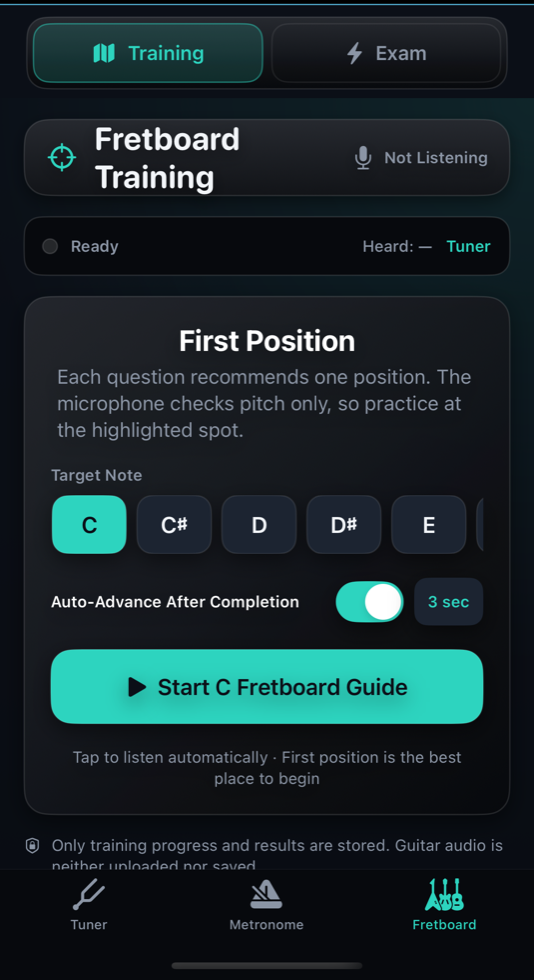
Actual development-build interface, cropped only to remove the internal diagnostic header.
Included from day one
One iPhone app connects the three jobs: prepare the instrument, keep time, and learn where notes live by answering on a real guitar.
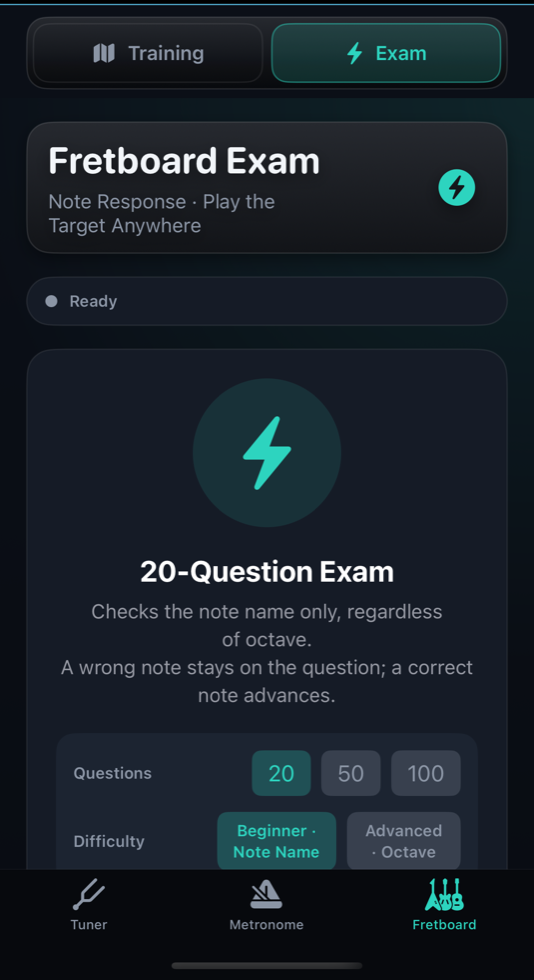
Train deliberately or test recall under time pressure with a real instrument.
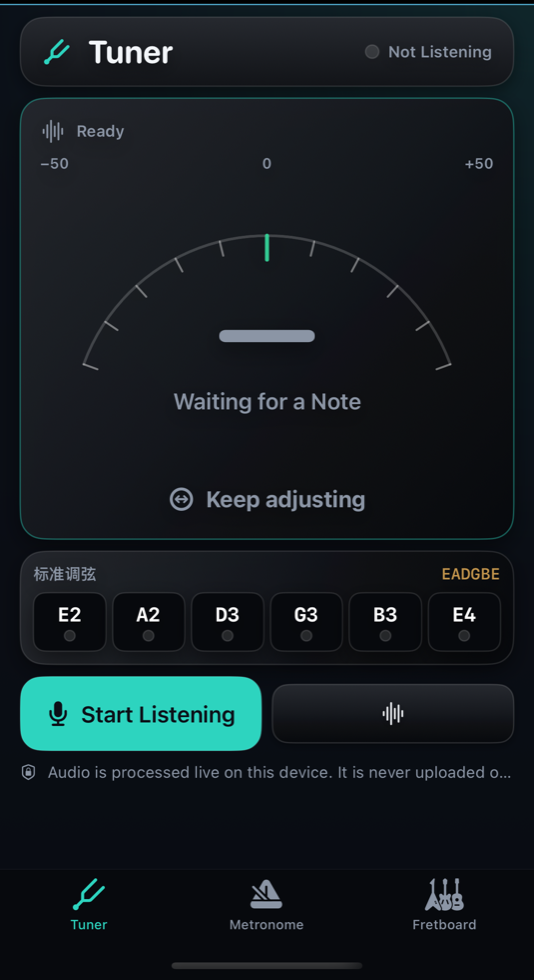
Standard tuning guidance and chromatic pitch checks are available without purchase.
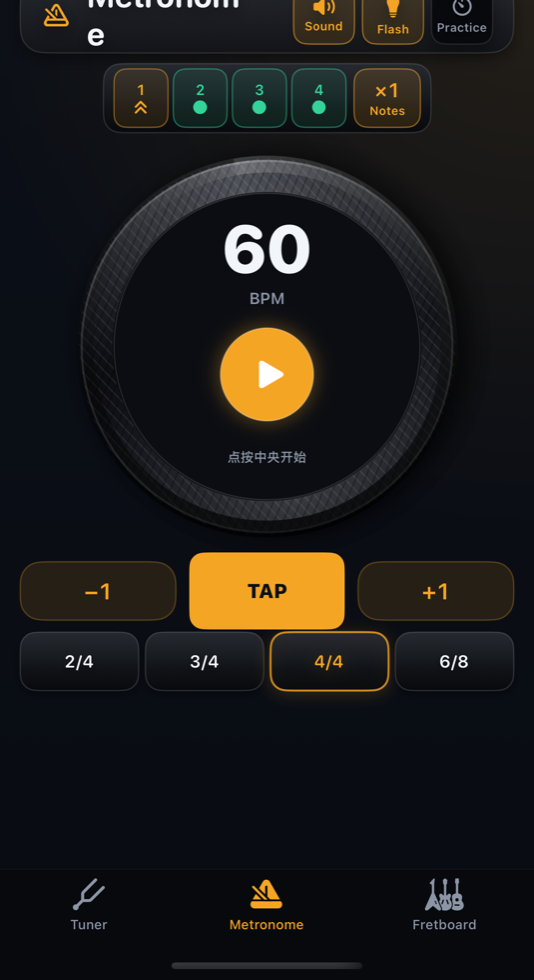
The full tempo range is free: 1–240 BPM on iPhone and 30–240 BPM on Apple Watch.
Notes into relationships
Choose an exact string-and-fret root, confirm it on your guitar, then work through several interval targets anchored to that same root.
The microphone verifies pitch and octave. String and fret remain physical guidance because the same pitch can exist in more than one place.
Current feature: note and position-interval training are both included in the first release.
Planned first release
The commercial plan is a free download with an optional one-time purchase. Final price and release availability will be confirmed in the App Store.
Guitar Cue is preparing for the App Store. The final local price and release availability will be shown by Apple.
A few honest answers
No. The same pitch can exist in more than one place on a guitar. Guitar Cue evaluates the detected note and shows valid matching positions rather than inventing certainty.
No. The core experience runs on iPhone. A compatible paired Apple Watch can add supported controls and feedback after the companion flow is validated for release.
The current development build is designed to analyze microphone input live on the device without saving or uploading recordings. The final public privacy policy will be confirmed against the release build.
A standard-tuned acoustic guitar or clean electric guitar in a reasonably quiet room. Distortion and high background noise can reduce pitch-detection reliability.
Not in the current build. The first release focuses on recognizing individual notes across the fretboard. Guided learning for different scales is planned for a future version.